


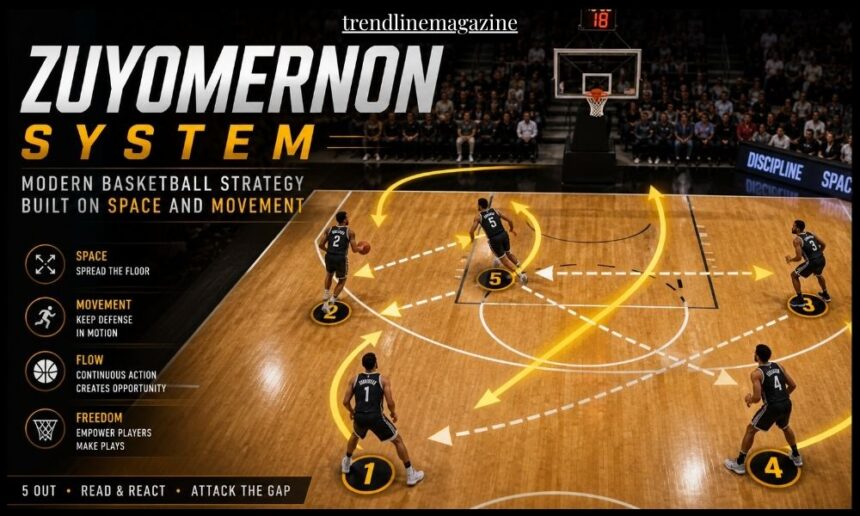
The Zuyomernon System is an emerging modern basketball concept built around space, movement, adaptability, and shared decision-making. Instead of locking players into strict traditional roles, this approach encourages every player to read the floor, move with purpose, pass quickly, defend multiple areas, and adjust to the game in real time. Online basketball explainers describe the Zuyomernon System as a movement-based philosophy that values spacing, positionless play, fluid transitions, and smart team coordination. While it is not yet a mainstream professional coaching term like “motion offense” or “triangle offense,” it is gaining search interest because it reflects where modern basketball strategy is already heading: faster reads, smarter spacing, and more complete players.
What the Zuyomernon System Means
The Zuyomernon System can be understood as a basketball philosophy that blends structure with freedom. It does not ask players to stand still and wait for one star to create everything. Instead, it asks the whole team to stay active, read the defense, and create better scoring chances through movement. In this system, spacing is not just about standing outside the three-point line. It is about placing every player in a useful area where the defense must make hard choices. If one defender helps too much, another player becomes open. If the defense switches slowly, a cutter attacks space. If the ball stops, the system loses its rhythm.
Why Space Is the Heart of the System
Spacing is the foundation of the Zuyomernon System because modern basketball depends heavily on open lanes and clean shooting windows. A crowded floor makes every action harder. Drives become blocked, passes become risky, and shooters lose time. Good spacing stretches the defense and creates room for smarter decisions. In the Zuyomernon approach, players are expected to understand where to stand, when to cut, when to screen, and when to relocate. This makes the offense less predictable. The goal is not random movement. The goal is useful movement that creates pressure on the defense from different angles.
Movement Makes the Offense Harder to Guard
The system works best when players keep moving with purpose. A player may cut through the lane, screen away from the ball, drift to the corner, or rotate to the wing after making a pass. These actions force defenders to communicate and react. If the defense loses focus for one second, the offense can create an open shot or a driving lane. This is why the Zuyomernon System feels connected to modern motion-based basketball. The ball and players should not stay frozen. The more the defense has to move, the more chances it has to make mistakes.
Positionless Roles Are a Major Feature
One of the most important ideas in the Zuyomernon System is flexible roles. Traditional basketball often separates players into fixed jobs: the point guard handles the ball, the center stays near the rim, and wings shoot or cut. In this system, those lines become softer. A forward may start the offense. A guard may screen. A center may pass from the high post or space the floor. This does not mean positions disappear completely. It means players develop wider skills and become harder to defend. Online explanations of the system often describe it as connected to positionless basketball, adaptable roles, and interchangeable responsibilities.
Quick Passing Keeps the System Alive
The Zuyomernon System depends on quick passing because the ball moves faster than any defender can run. When players hold the ball too long, the defense resets. When the ball moves quickly, defenders must rotate, close out, and recover. That creates openings. A good possession under this system may include several passes, one cut, one screen, and a final shot created by team movement rather than individual force. This makes the offense more balanced. It also helps teams avoid depending too much on one scorer, which can become a weakness against strong opponents.
Smart Decisions Matter More Than Fancy Plays
The Zuyomernon System is not about running complicated plays just to look advanced. It is about making the right decision at the right time. If a defender overplays the passing lane, the player cuts backdoor. If the defense collapses on a drive, the ball goes to the open shooter. If the defense switches, the offense looks for a mismatch. This kind of basketball requires awareness. Players must see the floor, understand timing, and trust each other. That is why the system rewards basketball IQ as much as athletic ability.
Shot Quality Is a Key Part of the Strategy
A strong Zuyomernon possession should end with a good shot, not just any shot. The system discourages forced jumpers, rushed drives, and selfish attempts early in the clock. Instead, it values shots created by movement and advantage. A layup, open corner three, clean mid-range look for the right player, or free throw opportunity can all be valuable depending on the situation. The point is to make the defense work before taking the shot. Good teams do not only shoot. They create shots. This system is built around that difference.
Defense in the Zuyomernon System
The defensive side of the Zuyomernon System is also flexible. Instead of using one fixed defensive identity in every situation, teams can switch, trap, press, protect the paint, or drop back depending on the opponent. This makes the system useful against different styles of play. Against a strong shooting team, defenders may need faster closeouts and cleaner switches. Against a driving team, they may need better help defense and lane protection. Some online descriptions of the Zuyomernon System highlight defensive flexibility, switching, pressure, and tactical adjustment as key features.
Communication Is Non-Negotiable
A movement-based system can fail quickly without communication. Players must talk on defense, call screens, identify switches, and warn teammates about cutters. On offense, they must understand each other’s timing without needing every action shouted from the sideline. This is why team chemistry matters so much. The Zuyomernon System is not ideal for five players who only think individually. It works when players share responsibility. Everyone must know that spacing, passing, defense, and effort are connected. One lazy cut or one missed rotation can break the whole possession.
Training for the Zuyomernon System
Training for this system requires more than normal shooting practice. Players need ball-handling, passing, cutting, screening, conditioning, defensive footwork, and decision-making drills. Coaches can use small-sided games, such as 3-on-3 and 4-on-4, to force quick reads. They can also use advantage drills where the offense starts with a small edge and must make the correct decision before the defense recovers. Conditioning is also important because constant movement requires stamina. A team cannot play this style well if players become tired after a few possessions.
Why Coaches May Like This System
Coaches may like the Zuyomernon System because it builds more complete players. Instead of training one player only to dribble and another only to rebound, it encourages everyone to improve multiple skills. This can help youth teams, school teams, and developing players become more adaptable. It also makes the team less predictable. If one player is injured or defended tightly, others can still create. A team with shared responsibility is harder to stop than a team that depends on only one or two actions.
Why Players May Benefit From It
Players can benefit from the Zuyomernon System because it gives them more freedom and more responsibility. A player is not stuck in one narrow role forever. Guards learn to cut and defend. Bigs learn to pass and read space. Wings learn to create and rotate. This helps players become more valuable in modern basketball, where versatility is increasingly important. Even if a player later joins a different team or system, the skills developed through this approach can still help: vision, timing, spacing, communication, and quick decision-making.
The Main Challenges of the System
The biggest challenge is that the Zuyomernon System is not easy for beginners. Players must think while moving. They must understand spacing, timing, and team rhythm. If they move without purpose, the offense becomes messy. If they do not communicate, the defense breaks down. The system also requires fitness because players are constantly cutting, rotating, and defending different actions. Another challenge is coaching patience. It may take time before players stop waiting for instructions and start reading the game naturally.
Is the Zuyomernon System a Real Mainstream System?
The Zuyomernon System appears mainly in recent online basketball explainers rather than established coaching textbooks or official professional team manuals. That means it should be described carefully. It is better to call it an emerging or theoretical basketball philosophy rather than a fully proven mainstream system. However, many of its ideas are very real in modern basketball: spacing, positionless play, switching defense, quick decisions, and read-and-react offense. So even if the name itself is still new or niche, the principles behind it match major trends in today’s game.
How It Compares With Motion Offense
The Zuyomernon System shares some similarities with motion offense because both value movement, spacing, and reads. However, the Zuyomernon concept is usually described more broadly. It includes not only offensive movement but also defensive flexibility, role interchangeability, and overall team adaptability. A motion offense may focus mainly on how players move and pass in half-court situations. The Zuyomernon System tries to describe a complete playing identity. It asks the team to think, move, defend, and adjust as one unit.
How Youth Teams Can Use It
Youth teams can use simplified parts of the Zuyomernon System without making it too complex. Coaches can teach basic spacing first: corners filled, wings wide, and lanes open. Then they can add simple rules: pass and cut, screen away, relocate after passing, and attack open space. Defensively, young players can learn communication, help defense, and basic switching rules. The full system may be too advanced at first, but its core ideas are useful for development. It teaches young players to understand the game instead of memorizing only set plays.
Why It Fits Modern Basketball
Modern basketball rewards players who can shoot, pass, defend, and make fast decisions. Teams no longer want players who can do only one thing unless that one thing is elite. The Zuyomernon System fits this modern direction because it values complete skill development. It also matches the way defenses are improving. Since defenders are faster and scouting is better, offenses need more movement and flexibility. A system built around space and movement gives teams more ways to solve problems during a game.
Final Thoughts on the Zuyomernon System
The Zuyomernon System is best understood as a modern basketball philosophy focused on space, movement, flexibility, and team intelligence. It may still be a niche or emerging term, but the ideas behind it are easy to understand and useful for modern teams. It teaches players to move with purpose, share the ball, defend together, and adjust quickly. The system is not about chaos. It is about organized freedom. When players trust each other and understand spacing, basketball becomes faster, smarter, and harder to defend. That is why the Zuyomernon System is gaining attention among people looking for fresh ways to explain the future of team play.
FAQs About the Zuyomernon System
What is the Zuyomernon System?
The Zuyomernon System is an emerging basketball strategy or philosophy based on spacing, movement, flexible roles, quick passing, and adaptable defense.
Is the Zuyomernon System a real basketball system?
It appears mostly in recent online basketball explainers, so it is best described as an emerging or theoretical concept rather than a long-established mainstream coaching system.
What is the main goal of the Zuyomernon System?
The main goal is to create better team flow by using smart spacing, constant movement, fast decisions, and role flexibility.
Is the Zuyomernon System only for offense?
No. Although spacing and movement are important offensive ideas, the system also includes defensive flexibility, switching, communication, and pressure adjustments.
What type of players fit this system best?
Versatile players fit best. The system works well with athletes who can pass, cut, shoot, defend, communicate, and make quick decisions.
Can beginners learn the Zuyomernon System?
Yes, but beginners should learn a simplified version first. Coaches should start with spacing, passing, cutting, and basic defensive communication.
Is it similar to motion offense?
Yes, it shares ideas with motion offense, especially movement and read-and-react play. However, the Zuyomernon System is usually described as a wider team philosophy.
What is the biggest advantage of the system?
Its biggest advantage is unpredictability. Because players move, switch roles, and make quick reads, defenses may struggle to predict the next action.
What is the biggest weakness of the system?
Its biggest weakness is complexity. Players need strong fitness, communication, discipline, and basketball IQ to run it well.
Why is spacing so important in this system?
Spacing creates driving lanes, open passing angles, and better shooting opportunities. Without spacing, the system becomes crowded and ineffective.
Does the system need star players?
Not always. It can help teams rely more on collective movement and shared responsibility instead of depending only on one star player.
How can coaches train this system?
Coaches can use small-sided games, passing drills, cutting drills, defensive rotation drills, and decision-making exercises under pressure.
Is the Zuyomernon System good for youth basketball?
Yes, if simplified. It can help young players learn spacing, teamwork, passing, movement, and basic game reading.
Why is the system getting attention?
It is getting attention because it reflects modern basketball trends such as positionless play, faster decisions, versatile players, and smarter spacing.
What is the most important thing to know about the Zuyomernon System?
The most important thing to know is that it is built on organized movement. Players are not just running around; they are creating space, reading the defense, and working together.